

Purchase orders often look like an administrative detail. Until you see how much time teams lose retyping order lines, checking prices, hunting for discrepancies and re-entering data into the financial administration.
For B2B organizations with many suppliers, changing product ranges or recurring orders, that quickly becomes a bottleneck. The solution is rarely yet another spreadsheet, but a reliable data flow between supplier, order process and administration.
In this article you will read how to automate purchase order lines with supplier APIs. Not as a stand-alone technical trick, but as part of a process that delivers control, speed and insight.

A warehouse with stock and parcels as context for supplier data and purchase order lines.
Why manual purchase order lines keep coming back
Many purchasing processes started out pragmatically. A supplier sends a file, an employee copies the lines into a template and finance processes the invoice later in a separate system. That works as long as volumes are low and exceptions are rare.
As the number of orders, suppliers or product variants grows, familiar problems appear:
- Order lines are entered twice in different systems.
- Prices, quantities or item codes differ from what was agreed earlier.
- An error is only discovered during invoice checks or on delivery.
- Teams spend time searching, emailing and correcting.
- Management lacks real-time insight into status, discrepancies and open actions.
Automating here does not mean giving up all control. It means letting software handle the repeatable steps and reserving human attention for the exceptions.
What a supplier API adds to your purchasing process
A supplier API is a technical connection that lets your system fetch or send structured data to a supplier. Think of product information, prices, availability, order statuses or order confirmations.
The difference with loose Excel files or emails is mainly the reliability of the data flow. You fetch information from an agreed source, in a fixed format and at a moment that suits your process.
For purchase orders, supplier APIs are especially interesting in processes where you regularly need the same kinds of data:
- Up-to-date product codes and descriptions.
- Availability and lead times.
- Contract prices or tiered prices.
- Order confirmations and changes.
- Status updates for delivery or processing.
At House of Devs we look at more than the connection itself. We design the entire process flow: which data is leading, where may a user step in, and when must an exception be blocked? That fits within our broader approach to automating business processes.

A developer works on a digital connection that links supplier data to internal systems.
From API data to usable order lines
An API does not automatically produce a good purchasing process. The raw data has to be translated into order lines your own systems understand. That is where data mapping becomes important.
With data mapping you define how fields from the supplier source correspond to fields in your own process. For example:
- Supplier item number to internal item number.
- Unit price to agreed cost price.
- Delivery date to requested receipt date.
- Currency and VAT code to administrative booking fields.
- Order status to an internal process status.
In practice, this is rarely a one-off table. Suppliers change fields, products disappear, price agreements change and systems have rules of their own. That is why the mapping has to be manageable. Not only by developers, but also by the people who know the process.
A mature solution makes clear which lines can be processed automatically and which lines need checking first. That way you prevent bad data from moving through your organization faster.
Validation and error handling determine success
The value of automation is not just speed. Above all, it is predictability. That is why you have to build in validations before order lines are passed on to the administration or follow-up processes.
Examples of useful checks are:
- Does the item number exist in the internal system?
- Does the price match the agreed price, or does the difference fall within tolerance?
- Is the supplier active and linked to the right administration?
- Are required fields filled in, such as currency, VAT code and cost centre?
- Does the quantity match the minimum order or packaging unit?
What happens when a check fails is at least as important. An error message in a log file is usually not enough. Teams need a workable queue with clear messages, context and actions.
Good error handling answers three questions:
- What is wrong with this order line?
- Who can fix it?
- Can the process continue, or must the line be held back?
That way automation does not become a black box. It becomes a controlled process in which exceptions are visible and solvable.

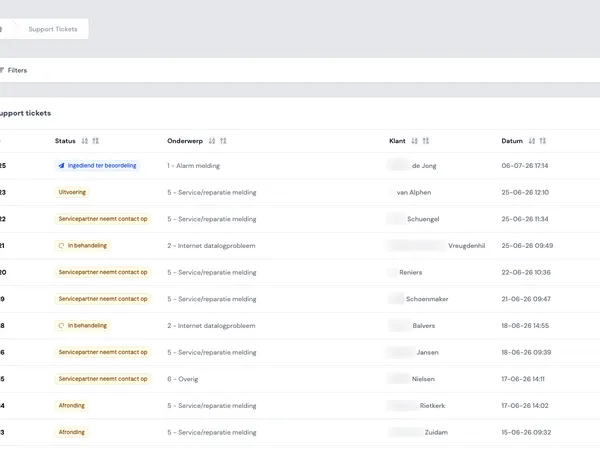
A dashboard on screens giving insight into order statuses, discrepancies and administrative processing.
Connecting to your financial administration
Purchase order lines only become truly valuable when they connect properly to the financial administration. That is where costs are booked, invoices matched and budgets monitored.
A connection with the administration requires more than passing on an amount. You often also need administrative context, such as supplier, general ledger account, cost centre, VAT code, currency and references to an order or project.
By validating this data at the order line, you prevent repair work later in the process. Finance then has less to correct and can focus on reviewing exceptions.
A practical approach is to build the financial connection in layers:
- Define which administrative fields are required per order type.
- When order lines are created or fetched, check whether those fields are available.
- Only pass validated lines on to the financial system.
- Put rejected lines in a clear queue with a reason and an owner.
- Make processing and errors visible in a dashboard.
The result is a chain in which purchasing, operations and finance work with the same data.
Dashboard: from processing to insight
Automating without insight leads to uncertainty. Teams want to know which orders have been fetched, which lines have been processed, which lines are stuck and how much manual work is left.
A dashboard helps you have that conversation based on facts. Think of overviews of:
- Number of processed order lines per supplier.
- Lines with price discrepancies or missing data.
- Lead time from fetching to administrative processing.
- Open errors per team or person responsible.
- Trends in manual corrections.
This fits a broader pattern we often see: spreadsheets are used as a temporary control tool, but grow into a critical system. In our article on replacing Excel with a real-time dashboard we go deeper into how to organize central data and better insight.
Example from practice: automated processing at XIXO
A concrete example is the XIXO case. It revolves around automated processing of purchase order lines via supplier APIs, linked to the financial administration and made visible in a central dashboard.
What makes a solution like that interesting is not just the technology. The value lies in bringing together three parts that often exist separately:
- Supplier data from external sources.
- Internal rules for order processing and control.
- Administrative processing and insight for finance and operations.
That makes the process more scalable. New order lines no longer have to go through the same steps by hand every time. Exceptions stay visible, but the standard flow runs on automatically.
How to start without rebuilding the whole process at once
The best start is usually not a big project in which everything changes at the same time. Begin with a well-defined flow with a lot of repetition, where errors have a measurable impact.
A workable first step often looks like this:
- Choose one supplier or order type with sufficient volume.
- Map the current manual steps and exceptions.
- Determine which API data is available and reliable.
- Design the mapping to internal order lines and administrative fields.
- Build in validation and error handling from the start.
- Make processing visible in a dashboard.
- Only then expand to more suppliers or processes.
That limits the risk and quickly shows you where the real complexity lies. That is why our way of working always starts with getting the process, data and users clear. Read more about our approach if you want to know how we go from analysis to working software.
When is this interesting for your team?
Automating purchase orders with supplier APIs is especially interesting if your team structurally loses time to repetitive administrative work. It becomes even more urgent when errors are discovered late, for example during invoice checks or on delivery.
If you recognize several of these signals, it is worth examining the process flow:
- Employees copy order lines from emails, portals or spreadsheets.
- Suppliers deliver data in different formats.
- Finance regularly corrects missing or incorrect booking data.
- Teams have no central overview of status and exceptions.
- Growth immediately leads to more administrative capacity.
House of Devs helps B2B teams translate processes like these into reliable software, API connections and dashboards. Want to know where the biggest gains are in your purchasing process? Then get in touch. We will look concretely at your current flow, the available data and a feasible first step.