

Processing a shipment sounds simple. You read the documents from a grower, copy the products, enter quantities, check dates and put everything neatly into the system. But anyone who does this dozens of times a week knows how quickly it becomes boring, slow and prone to errors.
For Equaflor Carnations, a clear step has been taken here. In the Equaflor Portal, the AI Jobs module automatically turns grower documents into a draft shipment. An employee no longer has to type everything line by line, but only needs to review it.
What previously took 10 to 20 minutes per shipment is now ready for review in about 15 seconds. And importantly: this is a first version, an initial draft, which in practice already works better than expected beforehand. More than 100 real shipments have been processed successfully in this way, with 100% accuracy in that processing.
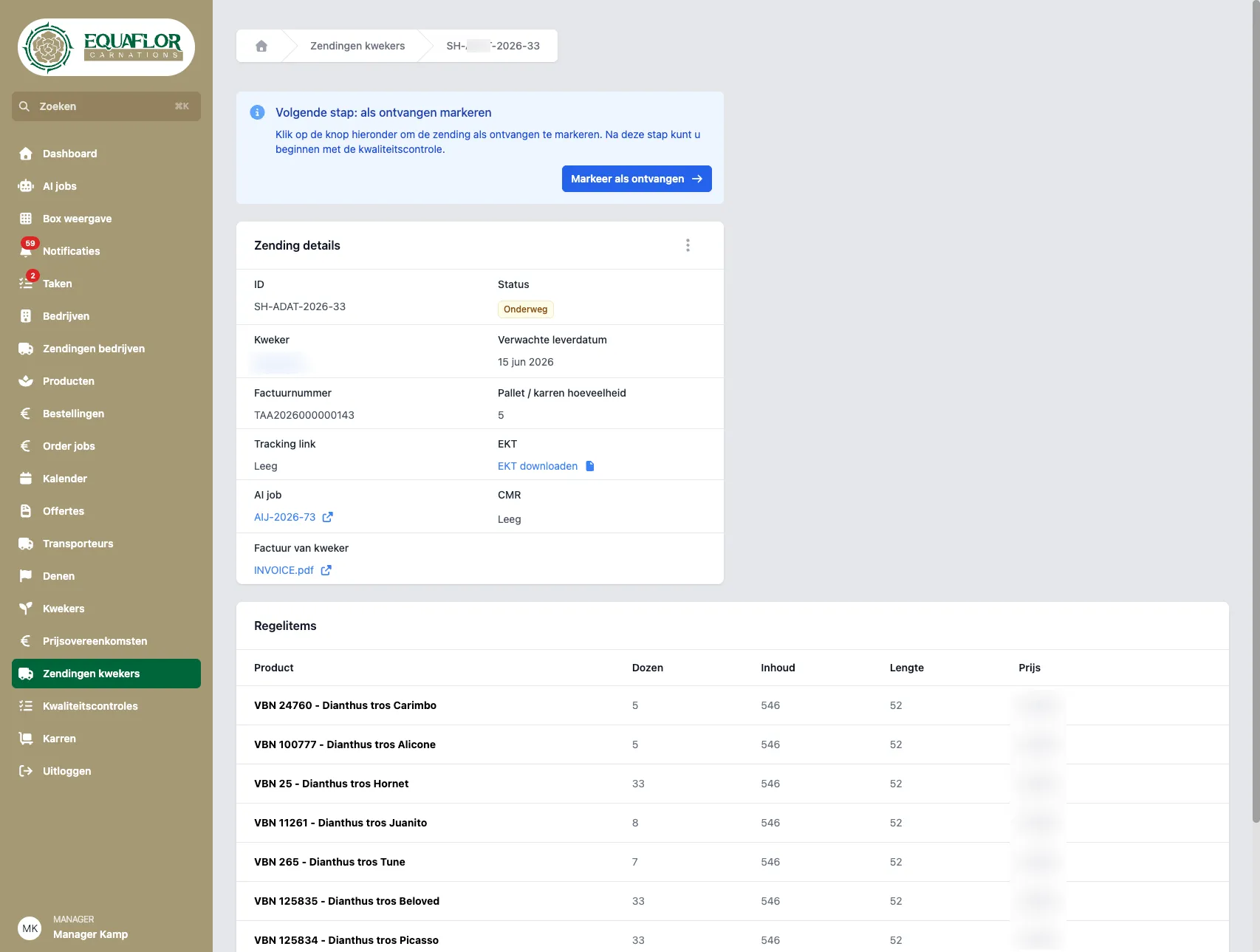
Detail page of a shipment created by AI in Equaflor.
The Equaflor Portal
The Equaflor Portal is the central online working environment of Equaflor Carnations. It is used to manage orders, quotations, shipments, quality checks, transport and other daily processes.
Users only see the sections that are relevant to their role. This means customers, growers, logistics employees and managers all work from the same environment.
By bringing all information together in one place, processes run more efficiently and everyone keeps working with the same up-to-date data.
Where AI makes the difference
The biggest gain lies in processing separate documents from growers. Growers provide their information in different ways. Sometimes as an invoice, sometimes as a packing list, sometimes as an Excel file, PDF or photo. For a person, that means opening, reading, interpreting and retyping.
That may sound small, but over the course of a week it adds up quickly. Equaflor creates about 20 to 40 shipments per week in this way. If each shipment saves 10 to 20 minutes of manual work, that amounts to about 3 to 13 hours of time saved per week.
That time saving is important, but it is not the only point. Manual copying is fragile. A misread quantity, a forgotten line or a product spelled slightly differently can cause problems later in the process. AI removes precisely that repetitive work. The employee remains responsible for the review, but no longer has to work like a typing machine.
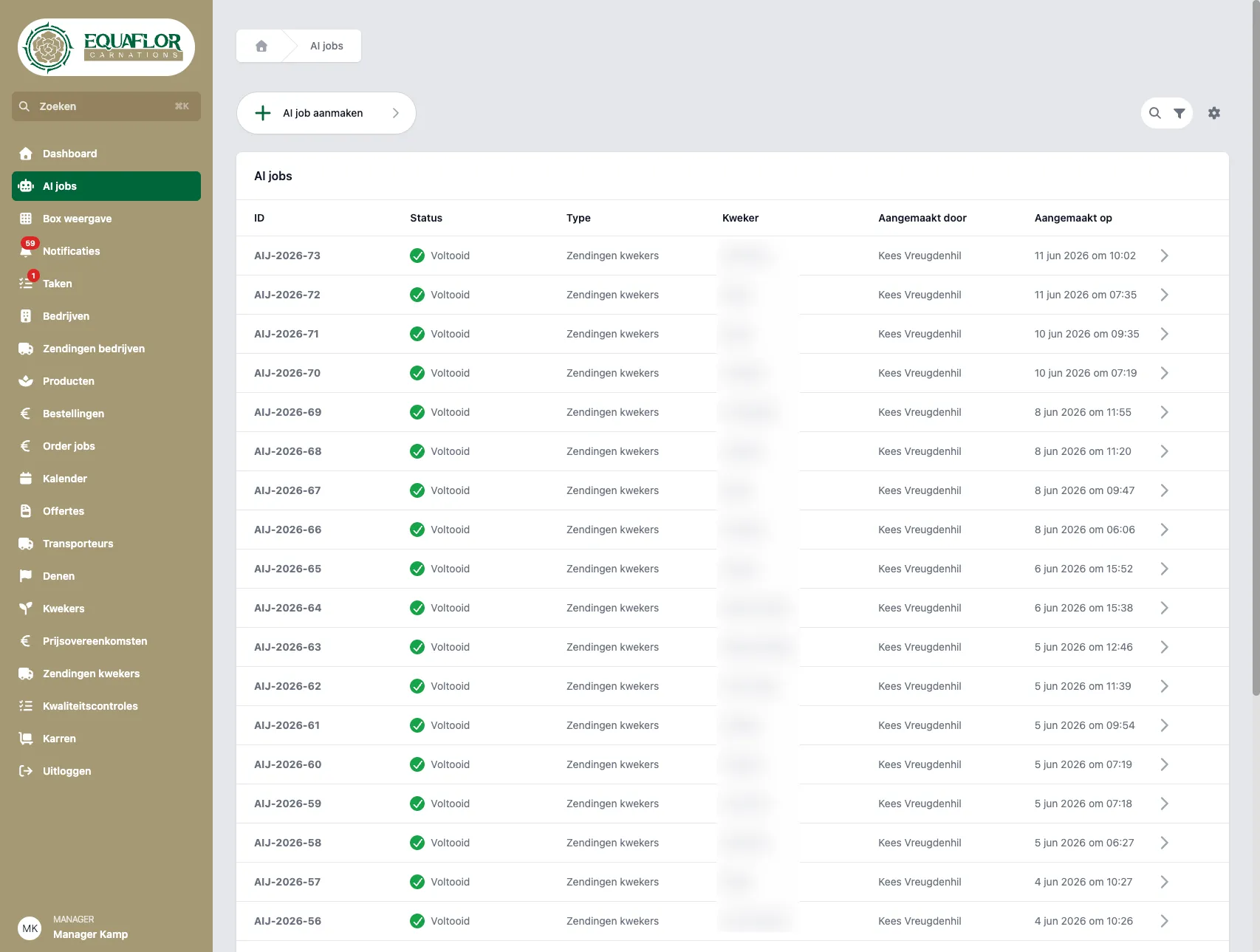
Overview of AI Jobs with the status and processing of shipments.
From document to AI draft in four steps
The user experience has deliberately been kept simple. A manager or administrator uploads the documents, selects the grower and starts the processing. After that, they can simply continue working. The system processes the files in the background.
In broad terms, the process works like this:
- The manager selects the grower and uploads one or more files, such as a PDF, Excel file or photo.
- The system reads the documents and extracts the most important information, such as products, quantities, prices, dates and comments.
- The information is converted into a draft shipment with the AI draft label.
- The manager receives a notification, opens the draft, checks the content and completes the shipment.
If a file cannot be processed correctly right away, the system tries again. Only files that truly cannot be read are set aside. In the overview, it is possible to see live whether a job is queued, in progress, completed or failed.
For the user, it therefore remains clear and manageable. Upload, continue with other work, receive a notification, review. The time-consuming intermediate step disappears.
Smart cleanup without extra manual work
Documents from growers are not always exactly the way Equaflor needs them. Sometimes lines need to be merged. Sometimes a grower uses their own product name. Sometimes quantities still need to be adjusted or comments need to be added.
For this, AI uses automatic follow-up steps specified by the administrator. In the portal, these are called callbacks. In plain language: small cleanup actions that are carried out according to fixed rules.
A concrete example is merging product lines that belong together. Think of lines with the same cart number or the same stem length. Previously, an employee had to recognize those lines from memory and combine them manually. Now such a step can happen automatically, every time according to the same rule.
Multiple cleanup steps can be placed one after another. One step then builds on the previous one. For example, the system can merge product lines, link grower names to the official product catalog, adjust quantities and add standard comments.
That is exactly where automation is strong: carrying out repeatable work consistently. Not guessing creatively, but completing fixed actions neatly. As a result, the chance of human copy errors is reduced even further.
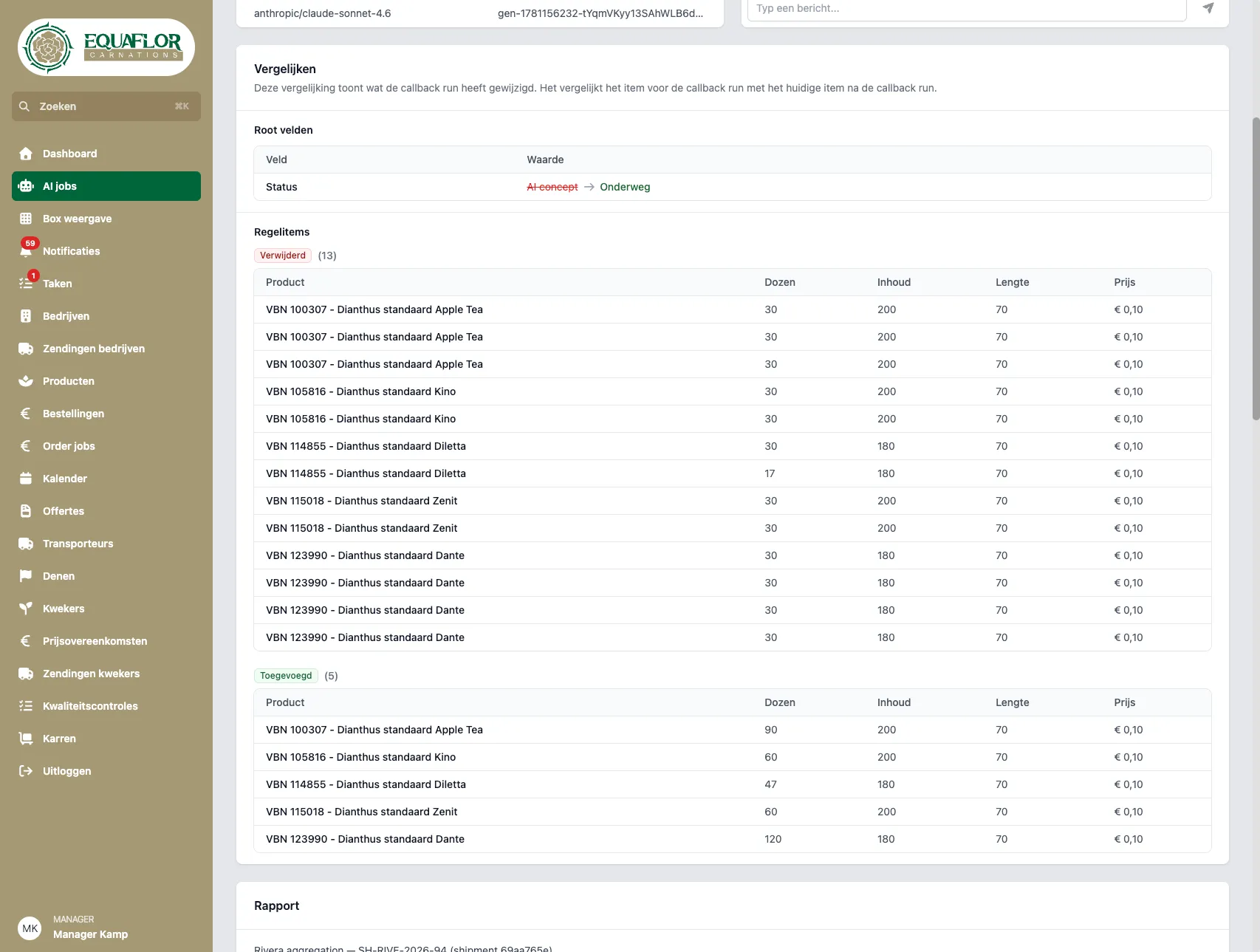
AI callback that merges product lines automatically.
Why there is a deliberate manual final step
AI does not finalize a shipment without human review. The result is always a draft. That is a deliberate choice.
The AI model does the heavy reading work and prepares the shipment. After that, a manager checks the products, quantities, prices and comments. If something needs to be adjusted, that can be done as usual. Only after that does the shipment continue as a normal shipment.
This makes the system reliable in practice. It combines speed with control. The employee no longer has to spend fifteen minutes typing, but still remains the person who makes the final decision.
Everything also remains traceable afterward. For each job, the system stores the uploaded files, what was read from them, the result and a short summary. This allows the team to look back, learn and improve instructions.
The system does not learn blindly, it follows clear instructions
An important part of the AI implementation is that the system does not simply try things at random. It works with instructions at two levels.
The first level consists of general instructions. These are the house rules for all growers. For example, they determine how a shipment is recognized, what a product line is and how dates and quantities should be read.
The second level consists of grower-specific instructions. Every grower has their own habits, own names and own documents. These additional instructions supplement the general rules and can override them where needed for that specific grower.
As a result, Equaflor does not have to force growers to all use the same form. The grower can continue working the way they are used to. The portal handles the differences and converts the information into the structure Equaflor needs.
Why this works better than having growers enter it themselves
A logical question is:
why not simply let growers enter their shipments themselves?
On paper, that sounds efficient. In practice, it shifts the work to the wrong place.
Growers want to be able to send their documents and move on. They are not concerned with the internal way Equaflor needs the data. If they have to do extra administration to make Equaflor’s process easier, it creates resistance and still results in error-prone work.
AI turns that around. The grower does not have to learn anything new. They continue submitting documents as before. The system translates them into a neat draft shipment. This removes manual work without making the chain more complicated for the people outside it.
What this shows about practical AI
The power of AI is not in a futuristic story. The power lies in a very concrete problem:
employees were spending a lot of time retyping, and errors could occur in the process.
Now that work has largely disappeared.
This first version now processes dozens of shipments every week. In practice, the saving is between 3 and 13 hours per week, depending on the number of shipments and their size. That is time no longer spent on boring copy work!
The next step is for growers to be able to upload their documents directly into the portal themselves. Then Equaflor will not even have to do the uploading anymore. The AI model prepares the draft shipment and a manager only performs the final review.
For teams that work a lot with documents, orders or shipments, this is the lesson: AI does not have to take over everything to be valuable. Above all, it has to remove the right work. Slow, repeatable and error-prone work is often the best place to start.
That is what we like to build at House of Devs: software that fits the way people really work and gives time back exactly where daily work causes friction.